
.svg)

What is the best restaurant inventory software?
What is the best restaurant inventory software for multi-unit locations?
TL;DR / Executive Summary
- Enterprise inventory software should bridge the gap between the kitchen floor and the P&L statement.
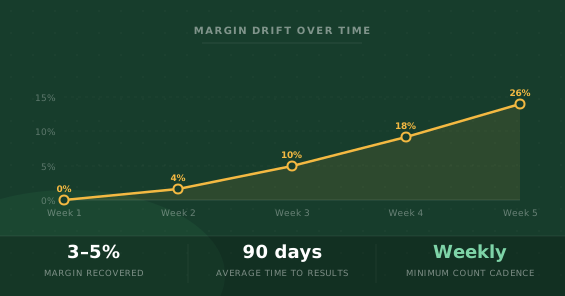
- Legacy systems and spreadsheets fail multi-unit operators by creating data silos and "margin drift."
- The best solutions offer real-time chain-wide inventory visibility and automated procurement.
- For UK operators, localized features like VAT handling and regional supplier integrations are non-negotiable.
- Weekly reporting is the minimum cadence required to protect margins in a high-inflation environment.
Dans cet article
- Enterprise inventory software should have centralized data control, not just reporting.
- Manual tracking costs multi-unit operators an average of 3–5% in undetected margin drift per month.
- 10 Essential features for multi-unit restaurant inventory software.
- London's top restaurant groups use commissary kitchen modules and automated EDI to manage stock across borders.
What operators need enterprise inventory software?
Unlike spreadsheet-based tracking, enterprise inventory platforms enable standardized item coding chain-wide, eliminating the manual reconciliation that causes margin drift.
Enterprise inventory software is designed for restaurant groups operating three or more locations, ghost kitchen networks, and franchise operators managing regional commissary kitchens.
Single-site operators can manage with simpler tools, but once locations share procurement, recipe libraries, or reporting, a centralized platform becomes essential to preventing margin drift and data fragmentation.
The best restaurant inventory software for enterprise operators centralizes procurement, recipe costing, and AvT variance in one platform
The best restaurant inventory software for enterprise operators is defined by one capability: the ability to standardize inventory control across every location simultaneously.
For UK multi-unit operators, this means real-time chain-wide visibility, automated procurement, and VAT-compliant supplier integrations and not just a low price point or a clean interface.
In the current European climate, marked by fluctuating supply costs and labor shortages, inventory is no longer a back-office chore; it's also a live financial lever. The best restaurant inventory management software acts as a single source of truth that connects procurement, recipe costing, and actual vs. theoretical (AvT) variance analysis.
How multi-unit restaurant operators track inventory across locations: a governance-based model?
Scaling from three locations to thirty introduces a "visibility tax." Without a centralized system, each site becomes an island of data. Enterprise operators can maintain control by moving away from reactive counting toward a governance-based model.
This involves:
- Centralized Database: Ensuring a "Beef Fillet" is coded identically in London and Manchester to allow for aggregate purchasing power.
- Digital Procurement: Automating the EDI (Electronic Data Interchange) flow between your multi-unit restaurant commissary kitchen inventory software and your suppliers.
- The Weekly Cadence: As seen in our inventory management best practices for multi-location operators, switching to a weekly inventory count cadence reduces margin drift by catching waste, theft, and portioning errors before they compound. Operators who count weekly report 2–4% better food cost accuracy than those counting monthly.
The goal isn't just to know what's on the shelf; it's to understand why the shelf doesn't match the sales data.
3 Most Common Inventory Mistakes Multi-Unit Operators Make
Most multi-unit operators don't lose margin to one catastrophic event; they lose it gradually, through repeatable mistakes that compound silently across locations. These are the three most common, and the most costly.
Mistake #1: Counting Monthly Instead of Weekly
Monthly inventory counts feel efficient but create a 30-day blind spot. By the time you identify a variance, whether from waste, theft, or portioning inconsistency, the loss has already compounded across every location for four weeks.
Operators who switch to weekly counts report 2–4% better food cost accuracy because problems are caught and corrected before they become patterns. Weekly counting is not more work; it is less damage control.
Mistake #2: No Centralized Item Coding
When "Beef Fillet 200g" is entered differently across locations (as "Beef Fillet," "Fillet Steak," or "B. Fillet 200"), your chain-wide data becomes impossible to consolidate.
You lose aggregate purchasing power, recipe costing accuracy breaks down, and AvT variance reports become unreliable. Centralized item coding, enforced at the HQ level, is the foundation every other inventory process depends on.
Without it, you are not running one business across multiple sites, you are running multiple disconnected businesses.
Mistake #3: No HQ-Level Permission Controls
Allowing site-level managers to edit prices, create new suppliers, or modify recipes without HQ approval introduces data integrity risk at scale. One unchecked price update in Manchester can distort COGS reporting across the entire chain.
Enterprise inventory platforms solve this with granular user permissions. Site managers can perform counts and submit orders, but only HQ can approve structural changes to the item library, pricing, or supplier terms.
This is not about distrust; it's about consistency.
The right enterprise inventory software doesn't just fix these mistakes — it makes them structurally impossible.
10 Non-Negotiables for Enterprise Restaurant Inventory Software
When evaluating platforms for the UK and European markets, ensure the system handles these enterprise-level complexities:
- Multi-Unit Hierarchy: Ability to view data by region, brand, or individual site.
- Commissary Kitchen Modules: If you prep off-site, you need multi-location inventory reporting that treats the commissary as both a supplier and a cost center.
- Actual vs. Theoretical (AvT) Variance: Identifying exactly where profit is leaking (waste, theft, or portioning).
- Localized Accounting Integrations: Seamless sync with Xero, Sage, or NetSuite.
- Automated Invoice Processing: OCR technology to digitize paper invoices instantly.
- Supplier Management: Managing lead times and "cut-off" windows for dozens of regional UK vendors.
- Nutritional & Allergen Tracking: Compliance with UK Food Standards Agency allergen labeling requirements directly from recipe data.
- Offline Mobile Counting: Inventory counts often happen in low-connectivity areas; the app should work without Wi-Fi.
- COGS Forecasting: Using historical sales data to predict future ordering needs.
- Granular User Permissions: Restricting "Price Edit" capabilities to HQ while allowing "Counts" at the site level.
How to Calculate Actual vs. Theoretical (AvT) Variance in a Restaurant
AvT variance identifies the gap between what your inventory should cost based on sales and what it actually cost — revealing waste, theft, and portioning errors in real time.
The formula:
Theoretical Cost = Recipe cost per portion × Number of portions sold
Actual Cost = Opening Stock Value + Purchases − Closing Stock Value
Variance = Actual Cost − Theoretical Cost
Variance % = (Variance ÷ Theoretical Cost) × 100
Example: If your theoretical food cost for a week is £8,000 but your actual cost is £9,200, your variance is £1,200 — or 15%. Anything above 3–5% signals a problem that needs investigating at the location or recipe level.
Enterprise inventory software like MarketMan calculates this automatically across every location, flagging sites where variance exceeds your defined threshold.
Explore MarketMan's Enterprise Solutions
Why enterprise inventory software is the only way to protect margins as you scale
The paradox of growth is that the more locations you open, the harder it is to maintain the margins that allowed you to grow in the first place. Selecting the right enterprise inventory management software for restaurant chains is the only way to break this cycle.
By centralizing data and automating the "busy work" of counting and ordering, you empower your culinary directors to focus on what matters: the plate and the profit.
FAQ
Question: What is the 80/20 rule in restaurant inventory?
Answer: The 80/20 rule in restaurant inventory means that 80% of your total inventory value comes from just 20% of your items — typically proteins and alcohol. Enterprise inventory software applies this principle by letting operators set high-frequency count cycles on those top 20% items, reducing variance and protecting margins without counting every SKU daily.
Question: Can I use Excel for multi-unit inventory?
Answer: Excel is not viable for multi-unit restaurant inventory management beyond a single site. It cannot enforce centralized item coding, has no automated procurement or EDI capability, and creates data silos that cause margin drift across locations. Most operators managing three or more sites require a dedicated platform with real-time chain-wide visibility.

Contributeurs
Rejoignez plus de 18 000 restaurants et recevez les meilleurs conseils gastronomiques dans votre boîte mail.
Vous pourriez également être intéressé par



Prêt à commencer ?
Parlez à un expert en restauration dès aujourd'hui et découvrez comment MarketMan peut aider votre entreprise.