
.svg)


Restaurant Chart of Accounts: How to Set One Up
Learn how to build a restaurant chart of accounts that tracks food cost and prime cost, not just totals. Discover the five categories, a numbering system that scales, common mistakes to avoid, and a free template to start from.
A restaurant chart of accounts is the organized list of every account your restaurant uses to record money moving in and out, grouped into five categories: assets, liabilities, equity, revenue, and expenses. It is the backbone of your bookkeeping, and a restaurant-specific version separates food and beverage costs so you can actually see your prime cost. Set it up right, and every report you run afterward makes sense.
Get it wrong, and the damage is quiet but constant. Miscoded expenses, a food cost number you cannot trust, and a profit and loss statement that raises more questions than it answers. This guide walks through the five categories, a numbering system that scales, and how to avoid the mistakes that make restaurant books messy.
Key takeaways
- A chart of accounts is your bookkeeping foundation. It is the master list of accounts that every transaction gets sorted into.
- Five categories organize everything: assets, liabilities, equity, revenue, and expenses.
- Restaurants need custom detail. Separate food and beverage sales and costs, and break out labor, so you can see food cost and prime cost clearly.
- Number your accounts in ranges so there is room to add accounts later without renumbering everything.
- Keep it lean. Most independent restaurants run well on 40 to 80 accounts. More detail is not better if nobody codes to it consistently.
- Build once, then leave it alone. Constant changes break the comparability of your reports.
Restaurant Chart of Accounts Template
Build your restaurant's books on a foundation that actually works. This free, fully editable Restaurant Chart of Accounts Template organizes every account by category and number, so your P&L and balance sheet tell you where the money really goes.

What is a restaurant chart of accounts?
A restaurant chart of accounts is a master list of every financial account your business uses, organized so that every dollar of income and every expense has one clear place to go. It is not a report you read. It is the structure underneath every report, from your profit and loss statement to your food cost percentage.
The industry reference for this is the Uniform System of Accounts for Restaurants, a standardized framework that gives operators a consistent way to categorize revenue and costs. You do not have to follow it to the letter, but starting from a restaurant-specific structure beats adapting a generic small-business template that has no idea what food cost is.
A well-built chart of accounts is what makes the rest of your restaurant bookkeeping work. Coding is faster, reports are accurate, and your accountant is not billing you to untangle mystery entries at year end.
What are the five categories in a restaurant chart of accounts?
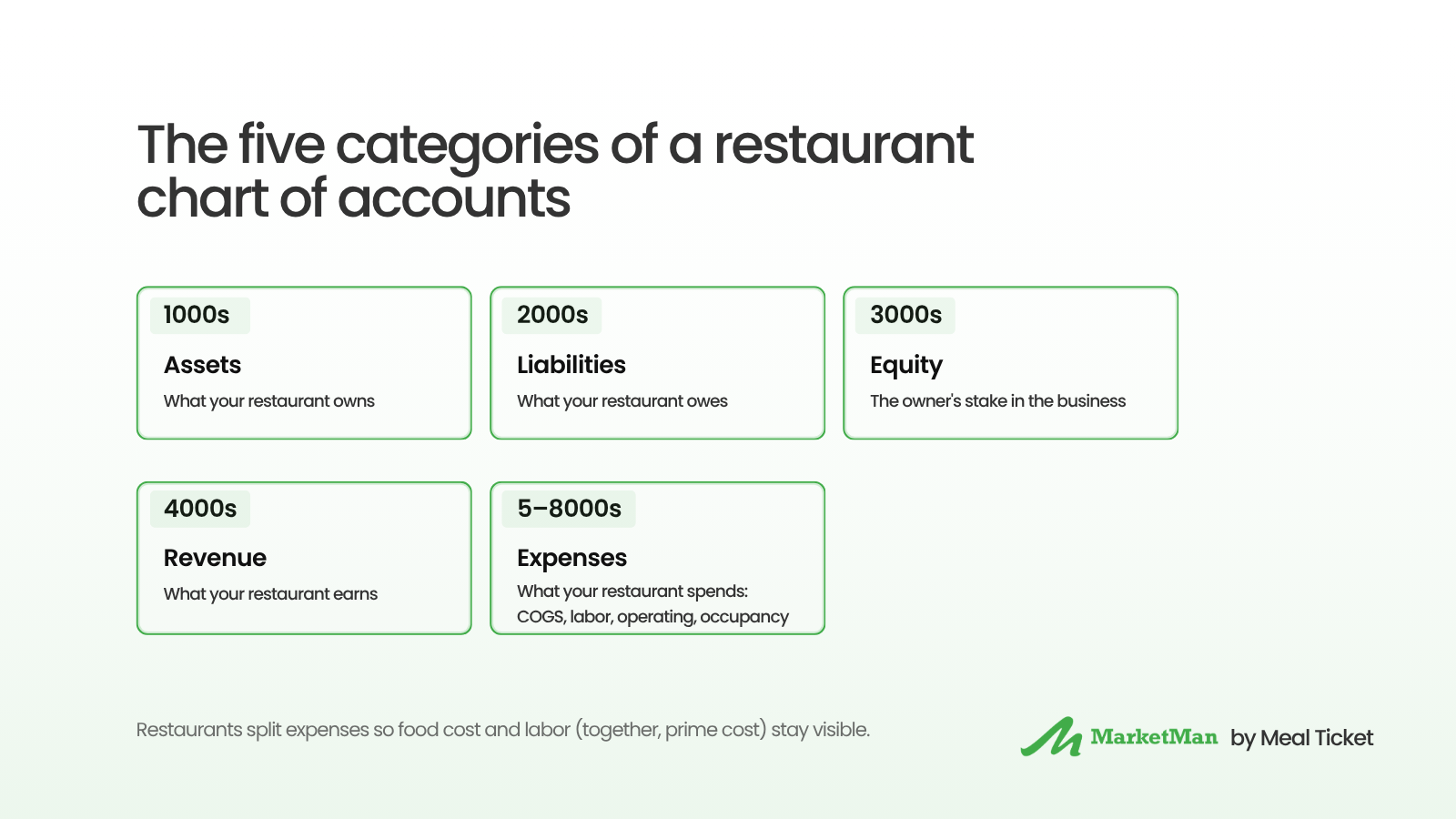
Every chart of accounts, restaurant or not, is built on five account categories. Each one answers a different question about your business.
Actifs
Assets are what your restaurant owns, and these accounts tell you what you have. Common asset accounts include:
- Cash (operating and payroll accounts)
- Food inventory
- Beverage inventory
- Accounts receivable
- Prepaid expenses
- Equipment and leasehold improvements
Passif
Liabilities are what your restaurant owes to others, and these accounts tell you what you owe. Common liability accounts include:
- Accounts payable (vendor invoices)
- Accrued payroll
- Sales tax payable
- Payroll taxes payable
- Credit card payable
- Gift cards outstanding
Fonds propres
Equity is what is left for the owners after liabilities are subtracted from assets. This is your stake in the business. Common equity accounts include:
- Owner's capital or contributions
- Owner's draws
- Retained earnings
- Partner or shareholder equity (if applicable)
Revenue
Revenue is the money your restaurant earns, and this is where restaurant-specific detail starts to matter. Split it out so you can see where sales actually come from. Common revenue accounts include:
- Food sales
- Beverage sales, alcohol
- Beverage sales, non-alcohol
- Catering sales
- Delivery and online ordering sales
- Discounts and comps (a contra-revenue account)
Expenses
Expenses are the money your restaurant spends to operate, and for restaurants this is the biggest and most important category by far. It splits into four groups, covered in detail below. Common expense accounts include:
- Food cost (cost of goods sold)
- Beverage cost (cost of goods sold)
- Hourly wages (labor)
- Payroll taxes (labor)
- Marketing and advertising (operating)
- Rent (occupancy)
How should a restaurant organize expenses and COGS?
Restaurants should split expenses into cost of goods sold, labor, operating expenses, and occupancy, so the two biggest controllable costs (food and labor) are visible on their own lines. This is the single most important thing that separates a restaurant chart of accounts from a generic one.
Break expenses into these groups:
- Cost of goods sold (COGS): food cost and beverage cost, kept in separate accounts. This is what your inventory counts and invoices feed into, and it drives your food cost percentage. For the full picture on this line, see lowering cost of goods sold.
- Labor: hourly wages, salaried management, payroll taxes, and benefits. Kept separate from COGS and from other expenses so you can track labor cost and combine it with COGS to see prime cost.
- Operating expenses: everything else it takes to run the place. Marketing, supplies, repairs, credit card fees, and administrative costs.
- Occupancy: rent, utilities, property taxes, and insurance. These are largely fixed, so keeping them separate makes it obvious what you can and cannot control.
Structured this way, your chart of accounts hands you prime cost almost for free. COGS accounts plus labor accounts equals prime cost, the number that decides whether the month made money. A generic chart of accounts buries food and labor inside a single "expenses" bucket, and you lose that visibility entirely.
The difference between a generic and a restaurant-specific chart of accounts comes down to four things:
How do you number a restaurant chart of accounts?
Number your accounts in ranges, with each category assigned a block of numbers, so you can add new accounts later without renumbering everything. A standard restaurant numbering system looks like this:
- 1000-1999: Assets
- 2000-2999: Liabilities
- 3000-3999: Equity
- 4000-4999: Revenue (4000 food sales, 4100 beverage sales, 4200 catering, and so on)
- 5000-5999: Cost of goods sold (5000 food cost, 5100 beverage cost)
- 6000-6999: Labor
- 7000-7999: Operating expenses
- 8000-8999: Occupancy
Leaving gaps is the whole point. If food sales is 4000 and beverage sales is 4100, you have 99 open numbers between them to add sub-accounts as you grow. Numbering everything sequentially with no gaps means you are stuck renumbering the day you add a new revenue stream.
How do you handle multiple locations in your chart of accounts?
For multi-unit operators, add a location prefix or use a class or department field rather than duplicating the entire chart of accounts per site. Every location codes to the same account numbers, and the location dimension lets you report on one store, a region, or the whole group without maintaining separate structures. Keeping the underlying accounts identical across sites is what makes location-to-location comparison possible.
What mistakes make a restaurant chart of accounts messy?
The most common mistake is too much detail, closely followed by too little. A chart of accounts with 300 accounts nobody codes consistently is as useless as one with 15 that lumps everything together. Aim for enough granularity to see food cost, beverage cost, labor, and major expense lines, and stop there.
A few other traps worth avoiding:
- Combining food and beverage. Different margins, different stories. Always separate them.
- Burying COGS in operating expenses. If food cost is not on its own line, you cannot calculate food cost percentage, full stop.
- Miscoded invoices. Even a perfect chart of accounts fails if invoices get coded to the wrong account. Consistent invoice handling matters, and invoice management mistakes are a common source of messy books.
- Changing accounts mid-year. It breaks the comparability of your reports. Make structural changes at year end whenever possible.
For a broader look at where restaurant books go sideways, 5 common bookkeeping mistakes covers the rest.
How to set up your restaurant chart of accounts
Setting one up is straightforward if you work top down:
- Start from a restaurant-specific template, not a generic one. Use the free template below or a framework based on the Uniform System of Accounts for Restaurants.
- List your revenue streams and give each its own account: food, beverage, catering, retail, delivery.
- Build your COGS accounts to mirror your revenue, so food sales map to food cost and beverage sales map to beverage cost.
- Separate labor into its own range so you can track it and calculate prime cost.
- Number in ranges with gaps for growth.
- Have an accountant review it before you start coding, so it is tax-ready and consistent.
Once it is built, resist the urge to tinker. A stable chart of accounts is what lets you compare this March to last March and actually trust the numbers.
[ Infographic: restaurant chart of accounts structure — 5 categories + numbering ranges ]
Frequently asked questions
What is the difference between a chart of accounts and a general ledger?
A chart of accounts is the organized list of every account your restaurant uses. The general ledger is where the actual transactions post to those accounts. Think of the chart of accounts as the labeled folders and the general ledger as the paperwork filed inside them.
How many accounts should a restaurant chart of accounts have?
Most independent restaurants run well with 40 to 80 accounts. That is enough detail to track food cost, beverage cost, labor, and major expenses separately, without making daily coding a guessing game. Add detail only where it changes a decision you will actually make.
Should food and beverage be separate accounts in a restaurant?
Yes. Keep food sales, beverage sales, food cost, and beverage cost in separate accounts. Food and liquor have very different margins, and combining them hides which side of your business is making or losing money.
Can you use QuickBooks for a restaurant chart of accounts?
Yes. Customize it to separate food and beverage COGS, break out labor, and map to your POS. Start from a restaurant-specific template rather than the generic default.
How often should a restaurant update its chart of accounts?
Review it once a year and whenever something material changes, such as opening a location, adding catering, or launching online ordering. Avoid constant tweaks mid-year, because changing accounts breaks the comparability of your reports. Small, deliberate updates beat frequent ones.
Who should set up a restaurant's chart of accounts?
A restaurant accountant or bookkeeper who knows foodservice should build or review it, ideally using the Uniform System of Accounts for Restaurants as a base. Owners can start from a template, but a professional review makes sure your books are tax-ready and consistent. The goal is a structure everyone codes to the same way.
A well-structured chart of accounts gives your restaurant a clear financial framework, but that’s only part of the equation. To understand what’s really driving food costs and profitability, you also need accurate, timely data from your day-to-day operations. MarketMan helps restaurants connect purchasing, inventory, invoices, recipes, and food costs in one place, giving teams better visibility into the numbers behind their financial reports. See how MarketMan can help turn your restaurant’s operational data into clearer, more actionable insights. Get a demo today.
Contributeurs
Rejoignez plus de 18 000 restaurants et recevez les meilleurs conseils gastronomiques dans votre boîte mail.
Vous pourriez également être intéressé par



Prêt à commencer ?
Parlez à un expert en restauration dès aujourd'hui et découvrez comment MarketMan peut aider votre entreprise.